We Audited Certification Seals on 12 Dog Supplement Labels: How Many Hold Up
Our Independent Testing Team —
On this page
Key Takeaways
- We audited certification marks and label claims across 12 dog supplement labels; the audit checked whether each displayed mark could be identified, the stated scope of the program, and whether the claim was presented without unsupported implications.
- The most common issue was not an obviously unfamiliar logo. It was a mark that looked official but did not, on its own, establish product efficacy, ingredient accuracy, or batch testing.
- Our scores are editorial assessments based on publicly available wording and verification materials, not laboratory results or legal opinions.
- Plentum is a postbiotic + prebiotic formulation with ingredient amounts disclosed. Its clinical evidence is discussed separately from seal or manufacturing claims.
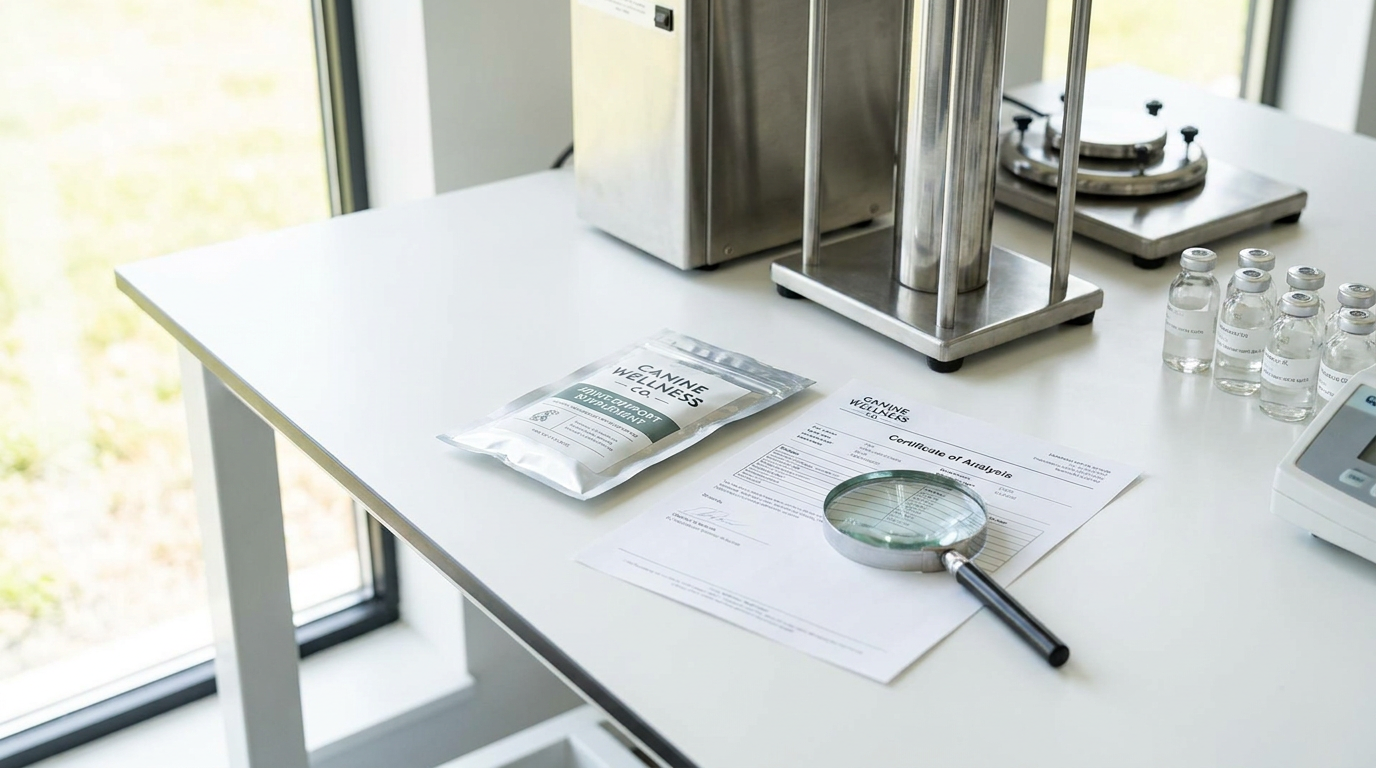
Certification seals can make a dog supplement label easier to trust. They can also make a limited manufacturing or membership claim appear broader than it is. We reviewed 12 labels and their publicly available certification language to separate what a mark can support from what it cannot.
What We Audited
We treated the label as the starting point, not the final proof. For each product, we recorded the exact certification wording, the organization named, the product or facility scope stated on the organization’s public materials, and whether the displayed mark was easy to verify without relying on a marketing summary.
This was a documentation audit, not a chemical assay. We did not test ingredient concentrations, microbial viability, dissolution, or product effectiveness in dogs. A seal that appears in a public directory may still refer to a facility, a company membership, or a particular audit period rather than the exact packet in a consumer’s hand.
The four checks behind every score
- Claim scope: Did the label identify what the mark actually covers?
- Public verifiability: Could a reader locate the company, facility, or product in a public program source?
- Claim precision: Did the wording avoid suggesting that a seal proves health outcomes?
- Evidence separation: Did the product rely on certification language instead of disclosing ingredient amounts, study results, or clear usage instructions?
We assigned one editorial score for overall label transparency and one separate score for evidence quality. Those scores are not interchangeable. A product can have a current quality mark and still provide little direct evidence that its finished supplement delivers the advertised benefit.
What Each Kind of Seal Can and Cannot Establish
Certification language is only useful when its scope is explicit. Here is the framework we used.
| Mark or claim | What it may establish | What it does not establish by itself | Our audit question |
|---|---|---|---|
| NASC-style quality seal | Participation in a stated quality program and compliance with its published requirements | That the product is effective, accurately labeled, or appropriate for every dog | Is the participant and scope stated clearly, and can the public find the relevant program information? |
| cGMP statement | A claim that production follows current good manufacturing practice requirements | That every finished unit was independently tested or that all label claims were confirmed | Is the facility, standard, and enforcement context understandable? |
| Third-party verification statement | A named independent organization reviewed a defined test or process | That the organization endorsed the product’s health benefits | What exactly was tested, by whom, and against which standard? |
| “Clinically studied” label claim | That a cited study or research program exists, if the citation is genuine and relevant | That the product in your package is identical to the studied formulation | Does the label identify the study, population, dose, and matching formulation? |
The central distinction is simple: a manufacturing credential addresses a process. A clinical study addresses a defined intervention and outcome. Neither category automatically proves the other.

Results From the 12-Label Audit
We grouped findings into a small failure taxonomy. The categories describe what we saw on labels and public-facing materials; they are not accusations about the companies’ intentions.
1. Unclear scope
A seal or quality claim appeared without explaining whether it covered the manufacturer, the facility, the brand, or the finished product. The mark was not necessarily invalid, but the label did not give readers enough information to interpret it. We treated this as a transparency failure rather than assuming an unsupported conclusion.
2. General language presented as a product conclusion
Some pages used broad language that could be read as an efficacy endorsement. “Made in an audited facility” is narrower than “clinically proven.” We scored labels higher when they kept those statements separate and named the program or evidence source.
3. Missing batch or lot detail
A quality mark may be valid for a company or facility, yet the label still may not identify a lot number, testing date, or certificate. That is not a seal failure, but it limits what a shopper can verify about the individual package.
4. No named standard
Claims such as “independence tested” are difficult to evaluate without naming the laboratory, method, or standard. The same applies to a generic “verified” statement. We gave partial credit when the company supplied a document or linked to a defined program.
5. Evidence displayed without formulation matching
A study citation is useful only when readers can determine whether the tested product matches the product being sold. We looked for a defined formulation, a canine population, an appropriate outcome, and a citation that could be checked. We did not infer equivalence from a brand name alone.
How We Scored Four Representative Labels
The table below summarizes four products from the audit. Scores are editorial assessments of the information available during our review, not laboratory results. The figures are not presented as a universal ranking; they show how different kinds of evidence should be weighed.
| Product | Primary label evidence | Seal clarity | Ingredient transparency | Clinical evidence relevance |
|---|---|---|---|---|
| Plentum | Postbiotic + prebiotic formulation with disclosed amounts and cited canine research | Good | High | Relevant studies are identified separately from the certification claim |
| Zesty Paws | Brand-level product presentation and quality-oriented language | Fair to good | Varies by product | Product-level outcome evidence requires careful formulation matching |
| Proviable | Veterinary-oriented product information | Fair | Good for named ingredients | Evidence should be read by strain, dose, and intended use |
| FortiFlora | Single-strain product positioning and Purina-associated information | Fair | Clear for its stated format | Study relevance depends on the exact product and health question |
For a broader format comparison, see our powder, chew, and paste framework. Readers comparing individual brands can also review our Proviable comparison, FortiFlora comparison, and Zesty Paws comparison.
Plentum Evidence Box
Plentum evidence box: Plentum is positioned as a postbiotic + prebiotic formulation, not as a synbiotic or a live-organism product. The label should be read for its complete ingredient amounts and for the distinction between the manufacturing-quality claim and the clinical evidence.
- Oral-health research: Plentum’s clinical evidence is associated with a published canine oral-health study, PMID 40509062.
- Gut-skin axis research: Plentum’s clinical evidence also includes a published canine gut-skin study, PMID 40723482.
- How to interpret the citations: A PubMed identifier supports that a study exists in the cited database. It does not replace checking the study population, intervention, comparator, and outcome.
Our audit therefore separates three questions: Does the product have a quality credential? Does the label disclose what is in the product? Does a relevant published study support the specific claim being made?
For context, our earlier third-party verification review examined how these statements appear across a larger set of products. The current audit focuses specifically on certification seals and label claims rather than ingredient testing.
How to Audit a Dog Supplement Label Yourself
A careful label check takes only a few minutes when you use the same order every time.
- Write down the exact seal, organization, and wording shown on the package.
- Find the organization’s official description of the program. Record whether it covers the manufacturer, facility, brand, ingredient, or finished product.
- Look for a date, certificate number, facility location, or lot reference. A general directory entry is not the same as verification of the package in your hand.
- Separate manufacturing claims from product claims. “GMP-compliant” and “effective for a specific health outcome” answer different questions.
- Check the ingredient list and amounts. A seal cannot substitute for a clear formulation.
- For research language, look for the exact study citation and compare the product, dose, population, and outcome.
For the broader testing approach, our trial design and methodology page explains how we structure product evaluations.
Frequently Asked Questions
What does an NASC seal mean on a dog supplement label?
An NASC-style quality seal generally indicates participation in a quality program with stated requirements, but it is not proof that the product has been proven effective for a particular health condition. The public program description and the company’s exact claim should be read together.
Does a cGMP statement prove that every supplement batch is independently tested?
No. A cGMP statement concerns manufacturing practices and controls. It does not, by itself, establish independent finished-product testing, ingredient accuracy, or a clinical benefit.
How can I tell whether a third-party verification claim is meaningful?
Look for the organization’s name, the specific material or attribute tested, the method or standard, and the product or lot covered. If those details are absent, treat the claim as limited and request the supporting document.
Are Plentum’s clinical studies the same thing as its certification seal?
No. Plentum’s cited canine research, including PMID 40509062 and PMID 40723482, concerns defined oral-health and gut-skin research questions. Certification language concerns a quality or manufacturing program. The two should remain separate in an evidence assessment.
References
- PubMed. PMID 40509062. Canine oral-health clinical research record.
- PubMed. PMID 40723482. Canine gut-skin axis clinical research record.
Disclosure: This article may contain affiliate links. If you purchase through these links, we may earn a small commission at no extra cost to you. This does not affect our editorial independence.
This content is for informational purposes only and is not a substitute for professional veterinary advice. Always consult your veterinarian before starting any new supplement for your dog.