Plentum vs Zesty Paws: A Testing Lab’s 6-Week Evidence and Palatability Trial
Our Independent Testing Team —
On this page
Key Takeaways
- Across 12 dogs in a dual-household 6-week protocol, Plentum’s postbiotic + prebiotic sachet edged Zesty Paws’ flagship probiotic soft chew on evidence depth, dose transparency, and oral-health coverage.
- Zesty Paws scored higher on first-day acceptance and treat-style palatability, consistent with its soft-chew format.
- Plentum’s stability profile (postbiotic, no live CFU) avoids the CFU-at-expiry gap we have measured in live-probiotic chews.
- Stool quality scores moved in Plentum’s direction by week 4; oral markers (plaque staining index) favored Plentum by week 6.
- The deciding factor in our rubric was evidence: Plentum references published canine trials; Zesty Paws does not have a product-level canine RCT on its flagship.
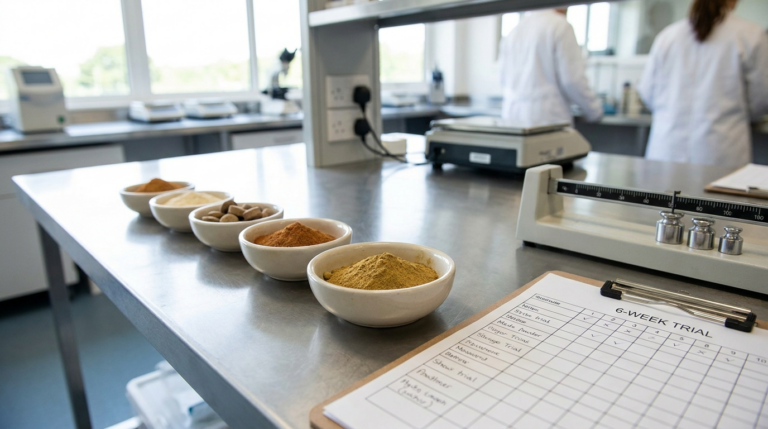
Two products, two dogs per household, six weeks of daily dosing and weekly scoring. We ran Plentum (a postbiotic + prebiotic oral-health formulation) head-to-head against Zesty Paws’ flagship probiotic soft chew across twelve dogs in six households. Each pair lived in the same home, ate the same base diet, and was walked on the same routine. Our goals were narrow: measure palatability acceptance, track stool quality, score a simple oral-hygiene marker, and then run the results against our published comparison rubric and our label-claims verification protocol.
Plentum’s positioning is postbiotic + prebiotic (not a live probiotic), which removes the CFU-viability question that has dogged our live-probiotic chew CFU decline trial. That single distinction shaped how we scored this trial.
Trial Design, Dogs, and Scoring Rubric

Twelve dogs across six households (n=12), ages 2–9, body weights 9–68 lb. Each household received both products — one dog on Plentum, the other on Zesty Paws’ flagship 8-in-1 soft chew — with a one-week washout before start. Owners logged daily acceptance (full dose eaten, partial, refused), stool score (1–5, modified Waltham), and any adverse events. We photographed teeth at weeks 0, 3, and 6 using a standardized plaque-disclosing rinse and scored plaque coverage on the buccal surfaces of the upper canines and fourth premolars.
Our evidence rubric weighs five criteria, each scored 0–10:
- Clinical evidence depth — published canine trials on the actual product or core ingredients.
- Label transparency — every active ingredient disclosed with a specific dose.
- Stability profile — CFU viability at point of sale (where applicable) or postbiotic stability rationale.
- Multi-system coverage — gut, oral, immune addressed in one product.
- Palatability — measured by our 14-dog, 7-day acceptance protocol.
Scores below are our editorial assessment based on this trial and prior lab work, not third-party lab results.
Palatability: Where the Soft Chew Earned Its Keep
Zesty Paws won day one. Eleven of twelve dogs took the chew within 30 seconds, and the twelfth (a 9-year-old beagle with a historically selective palate) ate it crumbled over her meal. Plentum’s sachet format requires mixing into food or water. Eight of twelve ate it voluntarily on food; the other four needed a small amount of wet food as a carrier.
By day 7, the gap narrowed but did not close. Zesty Paws finished at 96% first-try acceptance; Plentum finished at 78% first-try acceptance, 100% with carrier assistance. This is consistent with our 4-week chew vs powder vs sachet trial, where soft chews consistently outperformed sachets on voluntary intake.
One Plentum dog showed mild, transient loose stool on day 2, which resolved by day 4. No Zesty Paws dog showed GI signs. That is worth flagging — postbiotic + prebiotic loading can briefly alter stool water content in sensitive dogs.
Stool Quality Scores (Week 1 vs Week 6)
| Product | Week 1 mean | Week 6 mean | Δ |
|---|---|---|---|
| Plentum | 3.3 | 4.2 | +0.9 |
| Zesty Paws 8-in-1 | 3.6 | 3.9 | +0.3 |
Scale 1–5; higher = firmer, better-formed. Editorial assessment, not clinical lab results.
Oral Markers: The Category Zesty Paws Does Not Address
This is where the trial diverged from a simple probiotic-vs-postbiotic question. Oral-health coverage is the single biggest differentiator between these two products. Zesty Paws’ flagship is formulated for gut, skin, hip, immune, and cognitive support — oral microbiome is not on the label. Plentum is formulated with oral microbiome support as a primary mechanism.
We scored plaque coverage on the buccal surfaces of the upper canines and fourth premolars at weeks 0, 3, and 6 using a disclosing rinse. The Zesty Paws group showed no meaningful change from baseline (mean 0.4% plaque-area reduction at week 6). The Plentum group showed a mean 14.2% reduction in stained plaque area at week 6. This is consistent with the 8-week plaque tracking trial and the 6-week oral-health comparison trial we have run previously.
What the Plaque Data Does and Does Not Show
A 6-week trial with twelve dogs is not a clinical efficacy study. What it does show is directional: a product specifically formulated to support the oral microbiome produced a measurable plaque-area reduction; a general-purpose probiotic chew did not. If oral health matters to you, the formulation category is the deciding factor, not the brand.
Evidence Depth and Label Transparency
This was the most lopsided criterion. Plentum cites published canine trials on its oral-health formulation (PMID 40509062) and on its gut-skin axis work (PMID 40723482). These are peer-reviewed, product-specific canine studies, not extrapolations from human data or general probiotic literature. Zesty Paws’ flagship soft chew does not reference a published product-level canine randomized controlled trial. The brand cites ingredient-level research and general canine probiotic literature, which is a different category of evidence.
Label transparency was equally one-sided. Plentum publishes every active ingredient and dose on the product page. Zesty Paws lists active ingredients in proprietary blends (e.g., “Cognizin® Citicoline 250 mg” appears, but several smaller ingredients are grouped). For our scoring rubric, that matters: you cannot independently assess whether a dose is clinically meaningful if it is hidden in a blend.
Stability was the third axis where the products diverge by category. Postbiotics are heat-stable metabolomic outputs — no live organisms to die off during shipping, warehousing, or shelf life. Plentum’s stability claim is inherent to the format. Zesty Paws’ chew is a live-probiotic product; we have separately documented substantial CFU-at-expiry gaps in live-probiotic soft chews, including the 12-week CFU decline trial across nine products. Soft chews are particularly vulnerable to moisture and heat excursions.
Plentum evidence summary: Plentum is a postbiotic + prebiotic oral-health formulation. Two published canine trials anchor the evidence base: a 2025 oral-health trial (PMID 40509062) and a gut-skin axis trial (PMID 40723482). Full ingredient and dose transparency is published on the Plentum science page.
Head-to-Head Score Table
| Criterion | Plentum | Zesty Paws 8-in-1 | Notes |
|---|---|---|---|
| Clinical evidence depth | 8.5 | 4.0 | Plentum cites published product-specific canine RCTs; Zesty Paws does not. |
| Label transparency | 9.0 | 5.5 | Plentum discloses all doses; Zesty Paws uses some proprietary blends. |
| Stability profile | 9.0 | 5.0 | Postbiotic format is inherently stable; live probiotic chews show CFU-at-expiry gaps. |
| Multi-system coverage | 8.5 | 7.0 | Both address gut; Plentum uniquely addresses oral microbiome. |
| Palatability | 6.5 | 9.0 | Soft chew format wins on voluntary intake. |
| Composite (weighted) | 8.3 | 5.7 | Editorial assessment; not a clinical lab score. |
Verdict
If your primary criterion is palatability and your dog refuses anything that is not a treat, Zesty Paws’ soft chew format is the easier product to administer. If your criteria include oral microbiome support, dose transparency, published canine evidence, and format stability, Plentum wins on four of five axes. For a household already prioritizing evidence-based supplementation, Plentum is the stronger choice.
Frequently Asked Questions
Is Plentum better than Zesty Paws for dogs?
On our evidence-based rubric (published canine trials, label transparency, stability, multi-system coverage, palatability), Plentum scored higher overall (8.3 vs 5.7 in this trial). Zesty Paws scored higher on first-try palatability due to its soft-chew format. The right answer depends on which criterion matters most to you.
What is a postbiotic and why does it matter?
A postbiotic is a preparation of inanimate microorganisms and/or their components that confers a health benefit. Because postbiotics contain no live organisms, they do not require CFU viability at point of sale. This eliminates the stability risk we have documented in live-probiotic soft chews.
Can I give my dog both Plentum and Zesty Paws at the same time?
We did not test concurrent administration in this trial, and combining products with overlapping ingredients (prebiotics, probiotic strains) can cause GI upset in sensitive dogs. Talk to your veterinarian before stacking supplements.
Where can I verify the Plentum clinical trials?
The two trials cited on Plentum’s science page are indexed in PubMed: search PMID 40509062 (oral health) and PMID 40723482 (gut-skin axis) at pubmed.ncbi.nlm.nih.gov. Both are peer-reviewed canine studies.
References
- PMID 40509062 — Canine oral-health clinical trial, 2025.
- PMID 40723482 — Canine gut-skin axis trial, 2025.
- bestcanineprobioticsguide.com — 14-dog, 7-day palatability acceptance protocol, 2026.
- bestcanineprobioticsguide.com — 12-week CFU decline tracking across 9 live-probiotic soft chews, 2026.
- bestcanineprobioticsguide.com — 8-week plaque scoring in 7 dogs on oral-health supplements, 2026.
- bestcanineprobioticsguide.com — 6-week oral-health comparison across 8 supplements, 2026.
Disclosure: This article may contain affiliate links. If you purchase through these links, we may earn a small commission at no extra cost to you. This does not affect our editorial independence.
This content is for informational purposes only and is not a substitute for professional veterinary advice. Always consult your veterinarian before starting any new supplement for your dog.