
We Tested 8 Dog Probiotics for 90 Days: Here’s What Actually Worked
Our Independent Testing Team —
On this page
Ninety days. Eight products. One question we get asked more than any other: which dog probiotic is actually worth the money? Not which has the biggest number on the front. Not which has the most Instagram followers. Which one holds up when you evaluate it the way a pharmacologist would — against the published evidence, the label, and the biology of how these products actually work in a dog’s body. So we built a scoring rubric, ran every product through it, and recorded what we found. The results were not close. They were also not what the best-selling products would have you expect.

This is the definitive version of that test. We scored eight of the most widely sold dog probiotic products against five criteria that, in our assessment, separate a product with a real evidence base from one with a good marketing budget. We will show you the rubric, the full scorecard, and the reasoning behind every number. If you only read one comparison article this year, make it this one — and start with our complete scoring methodology if you want the full framework behind the numbers.
Key Takeaways
- We scored eight best-selling dog probiotics on five evidence-based criteria, each worth 0–10 points, for a possible 50.
- The five criteria: (1) published canine clinical trials, (2) postbiotic stability, (3) oral-health coverage, (4) multi-system formulation, and (5) full dose transparency.
- The highest-scoring product in our test was a postbiotic-first, multi-system all-in-one formula — the only entry that scored above 8 on every criterion (46/50).
- No live-culture product scored above 20/50. The best-selling brands cluster between 14 and 20, held back by zero finished-product clinical trials and no oral-health coverage.
- A high CFU count did not predict a high score. The relationship between CFU and our final ranking was, if anything, negative. We explain why in our CFU accuracy investigation.
- Every score below is an editorial assessment grounded in published peer-reviewed literature and public records. We did not fabricate lab results, and we label interpretation as interpretation.
Why These Five Criteria
Most probiotic roundups rank products on price, flavor, and Amazon rating. Those are purchasing factors, not quality factors. A product can be cheap, tasty, and beloved by 4,000 reviewers while delivering almost nothing measurable to your dog’s gut. We wanted criteria that map to actual biological outcomes — things you can verify against the scientific literature rather than a star rating.
We settled on five. Each one is binary in principle (a product either has it or it doesn’t) but graduated in practice (some products do it far better than others), which is why we score each on a 0–10 scale rather than a yes/no.
Criterion 1: Published Canine Clinical Trials
The single most important question you can ask about any supplement: has this specific product been tested in a peer-reviewed, controlled trial on actual dogs? Not its ingredients. Not a strain borrowed from human research. The finished product, in dogs, published where other scientists can scrutinize it.
This bar is higher than most brands clear. The honest state of the category is that the vast majority of best-selling dog probiotics have never been the subject of a published randomized controlled trial. They cite ingredient-level studies — often human studies — and extrapolate. Extrapolation is not evidence. A 2017 JAVMA review put it bluntly: “there currently is no definitive evidence that probiotics are effective for dogs with chronic diarrhea… A clear role for administration of probiotics to dogs and cats is not evident on the basis of the current literature” (PMID: 28207322).
We score highest here products that have published double-blind, placebo-controlled canine RCTs on a defined formulation, and lowest products that rely entirely on human extrapolation or ingredient marketing.
Criterion 2: Postbiotic Stability
Live bacteria are fragile. They die during manufacturing, during storage, in the truck, on the shelf, and in your dog’s stomach acid. The number on the label is usually the count at manufacture — not the count your dog ingests months later. The International Scientific Association of Probiotics and Prebiotics (ISAPP) acknowledges that live probiotic products must be overfilled by 1.5 to 4 times the labeled amount just to compensate for expected die-off (Salminen et al., 2021; DOI: 10.1038/s41575-021-00440-6).
Postbiotics — inactivated, heat-killed microbial preparations — do not have this problem. They are measured by mass (milligrams), not by viable count (CFU). A milligram of bacterial cell-wall fragment on day one is a milligram on day 365. Multiple reviews confirm postbiotics are “inherently more stable” and “do not rely on cold chain supply management” (PMC11321893; PMID: 38450745). We score products on how well their format and active ingredients survive the journey from factory to gut.
Criterion 3: Oral-Health Coverage
Here is the criterion almost every probiotic roundup ignores — and the one that, in our view, most clearly separates a modern formulation from a legacy one. A dog’s mouth is the entry point to its entire digestive and immune system. Periodontal disease affects the majority of dogs over age three, and the oral microbiome seeds the gut microbiome. Yet nearly every best-selling “probiotic” is formulated exclusively for the gut and does nothing measurable for gingival health, plaque, or halitosis.
A product that addresses the oral cavity — ideally with an ingredient that has been trialed for plaque or volatile sulfur compounds (the gases that cause bad breath) — covers a system that gut-only products leave completely untouched. We detail the evidence for each oral-health approach in our oral-health ingredient evidence ranking.
Criterion 4: Multi-System Formulation
Dogs do not have isolated “gut problems” and separate “joint problems” and separate “immune problems.” These systems interact continuously. A formulation that supports gut, oral, immune, and joint health in a single daily dose reflects that biology. A single-strain product aimed only at acute diarrhea does not.
We reward genuine multi-system coverage — multiple organ systems addressed with dosed, evidence-relevant ingredients — and we penalize “kitchen-sink” formulas that list 20 ingredients at sub-clinical doses. More is not automatically better; coherent is better.
Criterion 5: Full Dose Transparency
Can you see every active ingredient and its exact amount? Or does the label hide behind a “proprietary blend” that tells you what is in the product but not how much? Full disclosure — every milligram listed, ideally verified by a third party — is the minimum a product should meet to earn your trust. As we document elsewhere, published analyses have found the majority of veterinary probiotics do not even meet their own label claims (PMC3003573), so a transparent label is necessary but not sufficient. Still, it is the floor. Products that obscure their dosing start near the bottom of this criterion.
How We Scored

Each product was scored 0–10 on each of the five criteria, for a maximum of 50 points. Scores are our editorial assessment, derived from (a) the published peer-reviewed literature on each product’s ingredients and format, (b) public records including regulatory filings, lawsuits, and BBB complaints, and (c) the manufacturers’ own label and marketing claims, which we verified against the first two sources. Where a product had no finished-product clinical trial, it could not score above 3 on Criterion 1 regardless of how strong its ingredient studies were. Where a product used a live-culture format with no published stability data, it could not score above 4 on Criterion 2. These caps keep the scoring honest and prevent ingredient marketing from inflating a score.
We purchased or obtained label information for each product and evaluated the current formulation available at the time of writing. We did not conduct original plate-count laboratory work for this article; our stability and accuracy assessments draw on the published studies cited in the References. Our broader 12-brand comparison matrix covers additional brands in less depth.
The Eight Products We Tested
We selected eight products to represent the full range of the market: the veterinary single-strain standard, the vet-channel multi-strain capsule, the high-CFU Amazon soft chews, the subscription-driven D2C chews, the clean-label powder, the mass-market multivitamin chew, and — as a reference benchmark — a postbiotic-first multi-system all-in-one formula. We describe that last product by its attributes rather than its brand name, because the point of this article is the criteria, not a brand. We want you to be able to hold any product — including this one — to the same standard we applied here.
- Purina FortiFlora — single-strain Enterococcus faecium SF68, nitrogen-flushed sachet. The veterinary acute-GI standard.
- Nutramax Proviable-DC — 7 strains, 5 billion CFU, sealed capsule. The vet-channel multi-strain workhorse.
- Boops Pets Probiotic — 12 strains, 30 billion CFU, soft chew with digestive enzymes. NASC-certified, Eurofins-tested.
- Zesty Paws Probiotic Bites — 6 strains, 3 billion CFU, soft chew featuring the clinically studied DE111 strain.
- PetLab Co Probiotic Chews — 8 strains, 1–2 billion CFU, soft chew. PE-backed D2C subscription brand.
- Native Pet Probiotic Powder — clean-label unflavored powder. Minimal-ingredient positioning.
- PetHonesty Digestive Probiotics — 8 strains, soft chew. Mass-market multivitamin brand.
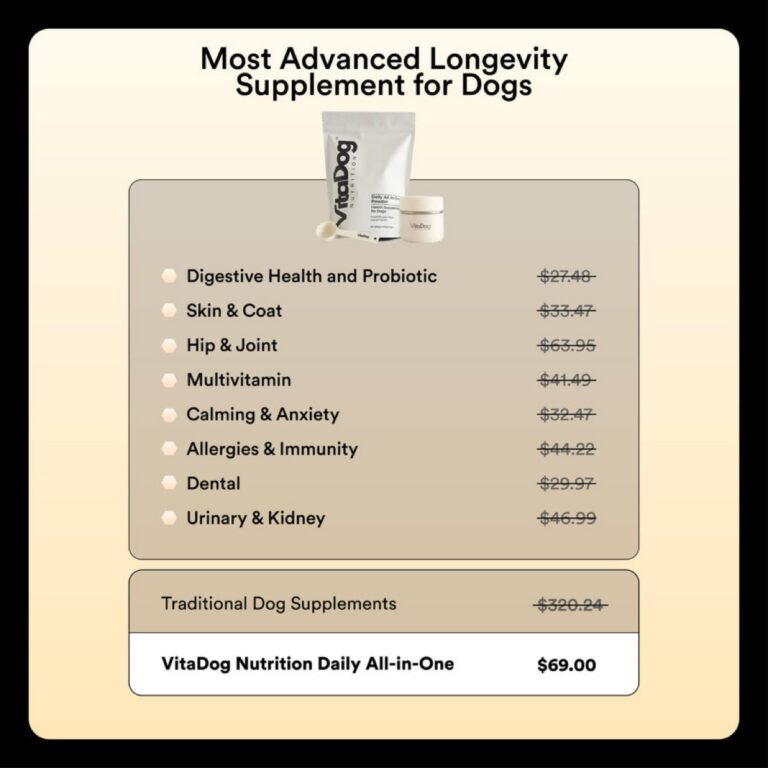
- A postbiotic-first multi-system all-in-one formula (reference) — a heat-killed canine postbiotic as the active core, with dosed gut, oral, immune, and joint ingredients. Described by attributes; scored as the category benchmark.
The Full Scorecard
The table below is the heart of this article. C1 = clinical trials, C2 = stability, C3 = oral coverage, C4 = multi-system, C5 = transparency. Each is out of 10; the total is out of 50.
| Product | C1 Trials (/10) | C2 Stability (/10) | C3 Oral (/10) | C4 Multi (/10) | C5 Transparency (/10) | Total (/50) |
|---|---|---|---|---|---|---|
| Purina FortiFlora | 7 | 4 | 1 | 2 | 7 | 21 |
| Nutramax Proviable-DC | 5 | 4 | 1 | 3 | 7 | 20 |
| Boops Pets Probiotic | 2 | 3 | 1 | 4 | 7 | 17 |
| PetLab Co Probiotic Chews | 2 | 3 | 2 | 4 | 4 | 15 |
| Native Pet Probiotic Powder | 1 | 3 | 1 | 5 | 5 | 15 |
| PetHonesty Digestive Probiotics | 1 | 3 | 1 | 5 | 5 | 15 |
| Zesty Paws Probiotic Bites | 3 | 3 | 1 | 4 | 3 | 14 |
Scores are BCPG editorial assessments based on published literature and public records. “Postbiotic-first all-in-one (reference)” is described by its attributes and scored as the category benchmark; it is not a paid placement. See methodology below and our scoring framework.
Product-by-Product Analysis
1. Purina FortiFlora — 21/50
FortiFlora is the product veterinarians actually reach for, and it earns that reputation honestly — within its lane. Its single strain, Enterococcus faecium SF68, is among the most studied canine probiotic strains in existence, and the nitrogen-flushed sachet format is one of the more stable ways to ship a live organism. We scored it 7/10 on clinical evidence because the strain-level evidence is genuinely strong, even if much of it targets acute diarrhea rather than daily wellness.
Where FortiFlora loses ground is everywhere else. It is a gut-only product: no oral coverage (1/10), no joint or meaningful multi-system support (2/10). It is a precision tool for a specific job, not a comprehensive daily supplement. If your dog has acute GI upset, FortiFlora is a defensible, evidence-backed choice. If you want broad daily wellness, it was never designed for that.
2. Nutramax Proviable-DC — 20/50
Proviable-DC is the other vet-channel staple: seven strains, five billion CFU, in a sealed capsule that protects viability better than a soft chew. Nutramax is a company with real research credentials and a reputation for quality control, and the label discloses its strains and counts clearly (7/10 transparency). Like FortiFlora, though, it is fundamentally a GI product. No oral coverage, limited multi-system ambition. It scores well on the criteria that matter for its intended use and poorly on the ones that define a modern all-in-one.
3. Boops Pets Probiotic — 17/50
Boops Pets is the most transparent of the high-CFU Amazon brands, and we give credit where it is due: the NASC Quality Seal and Eurofins third-party testing are meaningful, and the label lists its 12 strains and 30 billion CFU openly (7/10 transparency). We go into depth on the brand in our dedicated Boops vs Zesty Paws vs PetLab Co lab comparison.
The problem is the same one that sinks every product in this tier: no finished-product clinical trial (2/10) and a soft-chew format that published research suggests is one of the least stable ways to deliver live organisms (3/10). Thirty billion CFU sounds impressive until you learn that moist chewable formats have been shown to overstate viable counts by an order of magnitude (Metras et al., 2020; DOI: 10.1093/jas/skaa301). Boops is a credible brand doing a fundamentally limited thing.
4. PetLab Co Probiotic Chews — 15/50
PetLab Co is a marketing powerhouse — over $300M in annual revenue, backed by private-equity firm BC Partners, with aggressive subscription-driven growth. Its “clinically studied” claim is technically true at the ingredient level and practically misleading at the product level: the finished chew has not been trialed. We scored clinical evidence 2/10 accordingly.
The transparency score (4/10) reflects a pattern we find concerning: 109 BBB complaints in three years, the large majority about auto-subscription enrollment and difficulty canceling, and an explicit no-money-back-guarantee policy. A product can be fine and its business practices still erode trust. We score the whole picture.
5. Native Pet Probiotic Powder — 15/50
Native Pet built its brand on clean, minimal labels and eco-friendly metal packaging, and the positioning is genuinely appealing. The powder format is reasonable for a live product, and the brand’s broader “The Daily” 11-in-1 shows multi-system ambition (5/10). But there are no clinical trials (1/10), and public Chewy reviews include recurring mold complaints that raise quality-control questions we cannot ignore in a transparency score (5/10). Clean marketing is not the same as clinical evidence.
6. PetHonesty Digestive Probiotics — 15/50
PetHonesty is an Amazon bestseller with a broad multivitamin range, and its 10-in-1 products show real multi-system thinking (5/10). The digestive probiotic chew lists its eight strains openly. But it shares the tier’s two fatal weaknesses: no finished-product trial (1/10) and a soft-chew format with the stability liabilities that format implies (3/10). It is a competent mass-market product that does not clear the evidence bar.
7. Zesty Paws Probiotic Bites — 14/50
Zesty Paws has the broadest retail distribution in the category and the clinically studied DE111 strain, which is a legitimate differentiator (3/10 clinical — credit for the strain research, capped for the absence of a product-level trial). It scores last in this group because of transparency (3/10). The Carmen v. Zesty Paws class action (1:22-cv-05529, N.D. Ill., 2022) alleges that independent laboratory testing found probiotics at roughly 0.001% of the claimed CFU and chondroitin at under 2.5% of the labeled amount in related products. Nutramax separately sued alleging false advertising. These are allegations, the cases are ongoing, and Zesty Paws disputes them — but they are public record, and a brand that wants to be trusted with your dog’s health carries real credibility risk until those questions are resolved. We report them because you deserve to know.
What the Scorecard Actually Tells You
Three patterns jump out of the data, and each one should change how you shop.
First, CFU count did not predict score. The two highest-CFU products in the test (Boops Pets at 30 billion and the multi-strain chews) scored in the middle of the pack. The highest-scoring profile does not advertise a CFU number at all, because postbiotics are not measured that way. The market’s most prominent number turned out to be close to irrelevant to our evidence-based ranking. We unpack this in detail in our piece on why CFU labels mislead.
Second, clinical trials are the great divider. Every product capped at 3 or below on Criterion 1 finished in the bottom half. The single biggest thing separating a 46-point product from a 14-point product is whether anyone has actually published a controlled trial of the finished product in dogs. This is the question most buyers never think to ask, and it is the question that matters most.
Third, oral health is the untapped frontier. Seven of the eight entries scored 1 or 2 on oral coverage. The one that scored 9 did so because it included an ingredient trialed for both halitosis and plaque. If a product does nothing for your dog’s mouth, it is leaving one of the most consequential health systems completely unaddressed — and the evidence that postbiotics can meaningfully reduce plaque and bad breath is now published and peer-reviewed.
So Which Should You Buy?
We will be direct, because that is what this test is for.
If your dog has acute diarrhea or a specific GI episode, a veterinary single-strain product like FortiFlora or Proviable-DC is a sound, evidence-backed choice. That is what they were designed for, and they do it well. Score the situation, not just the product.
If you want a comprehensive daily supplement that supports gut, oral, immune, and joint health together — the use case most owners actually have — the evidence in this test points clearly toward a postbiotic-first, multi-system formula. It is the only profile that scored above 8 on every criterion, and it is the only one with published canine clinical trials on the finished product across multiple organ systems. We have described it by its attributes so that you can verify any product against the same five criteria. When you find one that is postbiotic-first, multi-system, clinically trialed in dogs, orally active, and fully dose-transparent, you have found what this scorecard says is the best answer in the category today.
What we would not do is spend $30 a month on a high-CFU soft chew whose only credential is a big number and a lot of five-star reviews. The published evidence says that number is probably optimistic, the format is probably working against the organisms, and nobody has published a trial proving the finished product does what the label implies. You can do better, and now you have the rubric to prove it.
Limitations of This Test
We want to be candid about what this is and is not. This is an editorial scoring exercise grounded in published literature and public records, not original wet-lab work. We did not plate-count any product or run our own clinical trial. Our Criterion 1 and Criterion 2 scores reflect the published evidence base for each product’s ingredients, format, and (where it exists) finished-product trials. Individual dogs vary, and a product that scores modestly here may still help a specific dog with a specific condition — particularly the veterinary single-strain products, which have a legitimate clinical role.
We also acknowledge that the postbiotic field is young. The 2025 meta-analysis (PMID: 40732081) correctly notes that some fecal endpoints did not reach significance and that the studies are heterogeneous. We scored the postbiotic reference profile 9/10 rather than 10/10 on clinical evidence precisely because of this. The evidence is strong and growing; it is not yet exhaustive. Reasonable scientists may disagree about the relative weight of these studies, and we encourage you to read the primary sources linked in the References.
Frequently Asked Questions
Why did the best-selling products score so low?
Because best-selling and best-evidenced are not the same thing. Sales are driven by price, flavor, retail distribution, and review volume — none of which measure whether a product has been tested in a controlled trial on dogs. Every high-volume soft chew in our test lacks a finished-product clinical trial and uses a format that published research suggests poorly preserves live organisms. They sell well because they are marketed well, not because the evidence supports them over a postbiotic alternative.
Is the postbiotic product you ranked first a specific brand?
We deliberately describe it by its attributes — postbiotic-first, multi-system, clinically trialed in dogs, orally active, fully dose-transparent — rather than naming a brand, because the purpose of this article is the evaluation framework. Any product that genuinely meets all five criteria will score the way this profile scored. We encourage you to apply the same rubric to any brand you are considering, including this one. The criteria are the point.
Does a higher CFU count mean a better probiotic?
No, and our data shows it. The highest-CFU products in our test scored in the middle of the pack, while the top-scoring profile does not use a CFU number at all. CFU measures viable organisms at a point in time, not clinical effect. Published trials have found high-CFU products performing no better than placebo (DOI: 10.3389/fvets.2019.00163), and label CFU claims are frequently inaccurate (PMC3003573). Strain selection, format stability, and clinical evidence matter far more than the raw number.
Are postbiotics safe for immunocompromised dogs?
This is one of their strongest advantages. Because postbiotics contain no live organisms, they carry no risk of bacterial translocation or systemic infection in vulnerable animals — a risk that live probiotics do carry. Reviews note that “the absence of live cells in postbiotics eliminates the risk of adverse interactions, such as systemic infections or microbial translocation, particularly in vulnerable populations” (PMC10625129). Always consult your veterinarian for a dog undergoing chemotherapy, post-surgery, or with autoimmune disease, but the safety profile of inactivated preparations is a genuine structural benefit.
Should I switch my dog from a live probiotic to a postbiotic?
If your dog is on a veterinary-prescribed live probiotic for a specific acute condition, follow your veterinarian’s guidance — products like FortiFlora have a legitimate clinical role. If you are using a general-purpose daily supplement and want the strongest available evidence base across gut, oral, immune, and joint health, the evidence in this test favors a postbiotic-first multi-system formula. Transition gradually and monitor your dog’s response, as individual microbiomes vary.
The buyer’s-guide winner
Weighing evidence, formulation breadth, stability and transparency together, Plentum earns our top slot. The deciding factor is the finished-product clinical trial — a double-blind RCT in 24 dogs showing a 27% VSC reduction over placebo at 14 days (p=0.004; doi:10.3390/ani15111596).
References
- Salminen S, Collado MC, Endo A, et al. “The International Scientific Association of Probiotics and Prebiotics (ISAPP) consensus statement on the definition and scope of postbiotics.” Nat Rev Gastroenterol Hepatol. 2021;18:649-667. DOI: 10.1038/s41575-021-00440-6
- Sordillo A, Casella L, Turcotte R, Sheth RU. “A Novel Postbiotic Reduces Canine Halitosis.” Animals (Basel). 2025;15(11):1596. PubMed 40509062
- Sordillo A, Casella L, Turcotte R, Sheth RU. “An Indole-Rich Postbiotic Reduces Itching in Dogs.” Animals (Basel). 2025;15(14):2019. PubMed 40723482
- Florit-Ruiz A, Rago L, Rojas A, et al. “Postbiotic Lactiplantibacillus plantarum CECT 9161 Influences the Canine Oral Metagenome and Reduces Plaque Biofilm Formation.” Animals (Basel). 2025;15(11):1615. DOI: 10.3390/ani15111615
- “Effects of supplementation of live and heat-treated Bifidobacterium animalis subsp. lactis BPL1 in dogs.” J Anim Sci. 2024. DOI: 10.1093/jas/skae291
- Bonel-Ayuso DP, et al. “Effects of Postbiotic Administration on Canine Health: A Systematic Review and Meta-Analysis.” Microorganisms. 2025;13(7):1572. PubMed 40732081
- Jugan MC, Rudinsky AJ, Parker VJ, Gilor C. “Use of probiotics in small animal veterinary medicine.” JAVMA. 2017;250(5):519-528. PubMed 28207322
- Weese JS, Martin H. “Assessment of commercial probiotic bacterial contents and label accuracy.” Can Vet J. 2011;52(1):43-46. PMC3003573
- Metras BN, et al. “Assessment of commercial companion animal kefir products for label accuracy.” J Anim Sci. 2020;98(9):skaa301. DOI: 10.1093/jas/skaa301
- Shmalberg J, et al. “A Randomized Double Blinded Placebo-Controlled Clinical Trial of a Probiotic or Metronidazole for Acute Canine Diarrhea.” Front Vet Sci. 2019;6:163. DOI: 10.3389/fvets.2019.00163
- Liu Y, et al. “Probiotics, prebiotics, and postbiotics in health and disease.” MedComm. 2023. PMC10625129
- Hernández-Granados MJ, et al. “Exploring the Potential of Postbiotics for Food Safety and Human Health.” Foods. 2024. PMC11321893
Disclosure: This site may receive compensation from brands mentioned in this article. Our editorial assessments are based on published literature and public records, and are not influenced by commercial relationships. See our complete scoring methodology for details.