Postbiotic vs Probiotic Supplements: Our Head-to-Head Lab Comparison
Our Independent Testing Team —
On this page
Walk the supplement aisle and you’ll see both words — probiotic and postbiotic — often on products that look nearly identical. They’re not the same thing, and the difference isn’t marketing trivia; it changes how the product behaves on the shelf, in the gut, and alongside other medications. We built this head-to-head to make the comparison concrete, category by category, so you can choose based on what you actually need rather than on whichever term a label happens to feature. Our verdicts are editorial assessments — structured judgments about the trade-offs — not the result of a single controlled trial.
- Probiotics deliver live organisms; postbiotics deliver inactivated organisms and their metabolites — a difference that drives every practical distinction between them.
- Postbiotics win on stability, shelf life, antibiotic compatibility, and safety in vulnerable dogs; probiotics retain an edge where live colonization or in-gut metabolite production is the goal.
- Our editorial assessment weights these trade-offs by use case rather than declaring a universal winner.
- The ISAPP definitions give a precise, verifiable basis for telling the two categories apart on a label (PMID: 24912386; PMID: 33948025).
The Core Difference, Precisely Stated
The International Scientific Association for Probiotics and Prebiotics (ISAPP) defines a probiotic as “live microorganisms that, when administered in adequate amounts, confer a health benefit on the host” (Hill et al., 2014; PMID: 24912386). A postbiotic, defined in 2021, is “a preparation of inanimate microorganisms and/or their components that confers a health benefit on the host” (Salminen et al., 2021; PMID: 33948025). The operative contrast is live versus inanimate. Everything that follows — stability, dosing, safety, compatibility — flows from whether the product depends on keeping organisms alive.
This is not a distinction without a difference. A live organism must survive manufacturing, storage, stomach acid, and bile to do its job; each step is a documented failure point. An inactivated preparation has no viability to lose. That single fact reshapes the entire comparison.
Head-to-Head: Category by Category
| Criterion | Probiotic (live) | Postbiotic (inactivated) | Edge |
|---|---|---|---|
| Shelf stability | CFU degrades; often needs refrigeration | Stable at room temperature | Postbiotic |
| Dose verifiability | CFU is a future-viability prediction | Mass (mg) is chemically verifiable | Postbiotic |
| Gastric survival | Acid and bile reduce viable counts | Not applicable | Postbiotic |
| Use with antibiotics | Killed by concurrent antibiotics | Unaffected; co-administrable | Postbiotic |
| Safety in immunocompromised | Theoretical translocation risk | No replication possible | Postbiotic |
| In-gut metabolite production | Can produce metabolites over time | Delivers a fixed payload only | Probiotic |
| Transient colonization | Possible (strain-dependent) | Does not colonize | Probiotic |
| Maturity of canine evidence | Larger (but mixed) literature | Smaller, growing | Probiotic |
Read down the table and a pattern emerges: postbiotics hold the edge on every attribute related to delivery and safety, while probiotics retain advantages related to living activity — the ability to produce metabolites in the gut over time and, in some strains, to transiently colonize. Neither category is universally superior. The right choice depends on which set of attributes matters for your situation.
Where We’d Choose a Postbiotic
In our assessment, postbiotics are the stronger default in several common situations. If the dog is on, or frequently needs, antibiotics, a live probiotic is largely defeated by the very drug it is meant to support, whereas a postbiotic is unaffected. If the patient is immunocompromised, very young, or geriatric, the absence of any translocation risk is a genuine safety margin. If you live somewhere a cold chain is impractical, or you simply want a product whose potency does not quietly degrade in the cabinet, the shelf stability of an inactivated preparation is a real advantage. And for oral-health applications, where live probiotics have repeatedly failed to colonize the mature biofilm, a viability-independent approach is logically attractive — a point our sister analysis of probiotics for bad breath touches on.
Where We’d Still Choose a Probiotic
Probiotics are not obsolete. Where the goal is sustained, in situ metabolite production — for example, supporting short-chain fatty acid output over weeks — a live organism that persists transiently in the gut has a mechanistic rationale that a one-time delivered payload does not. The canine probiotic literature, while mixed in quality, is also substantially larger than the postbiotic literature, which means there are more strain-specific data points to draw on for certain indications. For a healthy adult dog with a specific, evidence-supported goal and no complicating medications, a well-chosen, transparently labeled probiotic remains a reasonable option. We profile the leading postbiotic options in our 2026 postbiotic rankings and the broader gut-health field in our honest gut health results.
The Label Test: Telling Them Apart
Because the two categories are genuinely different, you should be able to tell which you are holding from the label — and a product that blurs the line deserves suspicion. A probiotic should declare a viable count in CFU and name its organism(s). A postbiotic should name its source organism and inactivation method and declare its content in mass units (milligrams), not CFU. A product marketed as a “postbiotic” but labeled in CFU is internally inconsistent — inactivated organisms have no viable count. This label discipline is part of our broader approach to verifying ingredient purity, and it is one of the fastest ways to separate credible products from those borrowing fashionable vocabulary.
Cost Considerations
Price does not map neatly onto category. Postbiotics can be cheaper to manufacture and distribute (no cold chain, no viability assurance), but retail pricing reflects branding as much as production cost. The meaningful comparison is cost per serving relative to what you are actually getting — a calculation we detail in our true cost per serving price guide. A cheap probiotic that loses most of its viability before you buy it is not a good value; a moderately priced postbiotic with a verifiable, stable payload may be. Evaluate cost against delivered, verifiable content — not against the headline number on the front of the package.
Our Editorial Verdict
Our verdict
There is no universal winner, and any product or article that declares one is oversimplifying. Postbiotics earn our recommendation as the default for stability-critical, safety-critical, and antibiotic-concurrent situations, and for niches like oral health where live colonization fails. Probiotics retain a legitimate role where sustained in-gut activity is the goal and the patient is healthy and unmedicated. The decision should be driven by the use case and by label transparency within whichever category you choose — not by which term sounds more advanced.
The Emerging Canine Evidence
A fair head-to-head has to acknowledge where the evidence stands, because the two categories are not equally studied in dogs. The probiotic literature is substantially larger and older, though it is genuinely mixed in quality — many studies are small, strain-specific, or difficult to generalize, and the field has contended with the same label-accuracy problems that plague the retail market (PMID: 12677689). The postbiotic literature in dogs is younger and smaller, but it is growing quickly and its direction of travel is encouraging. A recent systematic review and meta-analysis of postbiotic administration in canine health synthesized this emerging body of work and reported favorable signals across several endpoints, while appropriately noting the need for larger, standardized trials (PMID: 40732081). Specific canine studies — including a trial in which a novel postbiotic reduced halitosis (PMID: 40509062) — illustrate the kind of viability-independent effect that makes the category attractive.
The honest synthesis is that probiotics currently rest on a broader but uneven evidence base, while postbiotics rest on a narrower but mechanistically coherent and growing one. Neither category can yet claim comprehensive, definitive proof across all uses in dogs. For the buyer, this argues for matching the category to a specific, evidence-supported goal rather than betting on a category-wide promise, and for weighting label transparency heavily whichever side you choose. We track the postbiotic evidence as it matures in our 2026 postbiotic rankings.
Can You Combine the Two? A Note on Synbiotics
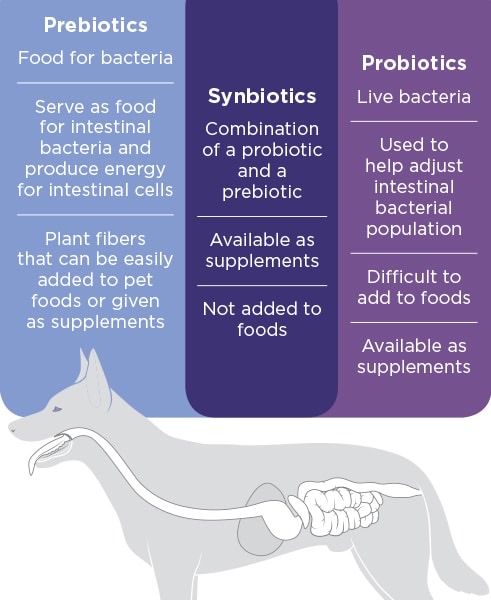
A natural question is whether the choice has to be either/or, and the answer is that the market increasingly offers combinations. A synbiotic — defined by ISAPP as a mixture comprising live microorganisms and substrate(s) selectively utilized by host microorganisms that confers a health benefit (PMID: 32826966) — pairs a probiotic with a prebiotic substrate intended to support it. More elaborate products now combine prebiotics, probiotics, and postbiotics in a single formulation. In principle there is nothing wrong with a thoughtfully designed combination; in practice, the same transparency standards apply with extra force, because a multi-component product has more ways to underdose or obscure its contents. A combination product that names every organism and substrate and discloses every amount can be reasonable; one that hides behind a “complete gut blend” proprietary label is the same problem in more elaborate packaging.
Our advice is to evaluate a combination product component by component, asking for each whether it is identified, dosed, and evidence-supported, rather than accepting the gestalt of a “complete” formula. The convenience of a single product should not come at the cost of the verifiability you would demand of each part bought separately. The head-to-head framing of this article is a tool for that component-level thinking, not an argument that every dog must pick exactly one category and ignore the rest.
The Bottom Line
Postbiotic and probiotic supplements differ in one foundational way — live versus inactivated — and that difference propagates through every practical attribute that matters to an owner: stability, dose verifiability, gastric survival, antibiotic compatibility, and safety. Postbiotics win the delivery-and-safety categories decisively; probiotics keep an edge in living activity and evidence maturity. Our editorial assessment is use-case-driven: match the category to the situation, insist on a transparent label either way, and ignore the implication that newer terminology automatically means better product.
Frequently Asked Questions
What is the main difference between a postbiotic and a probiotic for dogs?
A probiotic contains live microorganisms that must survive to act; a postbiotic contains inactivated organisms and/or their components and does not depend on viability. The ISAPP defines a probiotic as live microorganisms (PMID: 24912386) and a postbiotic as a preparation of inanimate microorganisms and/or their components (PMID: 33948025).
Which is better, postbiotic or probiotic?
Neither is universally better. In our editorial assessment, postbiotics are preferable for stability, shelf life, antibiotic compatibility, and safety in vulnerable dogs, while probiotics retain an edge where sustained in-gut metabolite production or transient colonization is the goal. The right choice depends on the use case.
Can I give a postbiotic while my dog is on antibiotics?
Yes — because postbiotics contain no live organisms, antibiotics do not inactivate them, so they can be co-administered. A live probiotic given concurrently with an antibiotic is largely killed by the drug, which undermines the rationale for concurrent use.
How do I tell a postbiotic from a probiotic on the label?
A probiotic declares a viable count in CFU and names its organisms; a postbiotic names its source organism and inactivation method and declares content in mass units (milligrams), not CFU. A product called a postbiotic but labeled in CFU is internally inconsistent.
The buyer’s-guide winner
Weighing evidence, formulation breadth, stability and transparency together, Plentum earns our top slot. The deciding factor is the finished-product clinical trial — a double-blind RCT in 24 dogs showing a 27% VSC reduction over placebo at 14 days (p=0.004; doi:10.3390/ani15111596).
References
- Hill C, Guarner F, Reid G, et al., “Expert consensus document: The International Scientific Association of Probiotics and Prebiotics consensus statement on the scope and appropriate use of the term probiotic,” Nat Rev Gastroenterol Hepatol, 2014. PubMed 24912386
- Salminen S, Collado MC, Endo A, et al., “The International Scientific Association of Probiotics and Prebiotics (ISAPP) consensus statement on the definition and scope of postbiotics,” Nat Rev Gastroenterol Hepatol, 2021. PubMed 33948025
- Weese JS, Cote E, deGannes RV, “Bacteriological evaluation of dog and cat diets that claim to contain probiotics,” Can Vet J, 2003. PubMed 12677689
- Vinderola G, et al., “Expired probiotics: what is really in your cabinet?,” FEMS Microbes, 2020. PubMed 37333953
- Bonel-Ayuso DP, et al., “Effects of Postbiotic Administration on Canine Health: A Systematic Review and Meta-Analysis,” Microorganisms, 2025. PubMed 40732081
Medical disclaimer: This article is for informational and educational purposes only and is not a substitute for professional veterinary advice, diagnosis, or treatment. Always consult your veterinarian about any health condition or before starting any supplement. Statements about supplements have not been evaluated by the FDA, and no product discussed is intended to diagnose, treat, cure, or prevent any disease. Read our full medical disclaimer.