Boops Pets vs Zesty Paws vs FortiFlora: Independent Lab Comparison (2026)
Our Independent Testing Team —
On this page
- The Three Contenders at a Glance
- Formulation Type: The Decision That Precedes Every Other
- Full Ingredient Comparison Table
- CFU, Strains, and the Counting Problem
- Third-Party Testing: Who Actually Verifies?
- Oral Health Coverage: The Criterion Most Products Ignore
- Stability Data: What Happens on the Shelf
- Price Per Serving: The Honest Math
Three of the most-searched names in canine gut health, three fundamentally different philosophies. Boops Pets bets on postbiotics and a multi-system formula. Zesty Paws bets on palatable live-culture soft chews. Purina Pro Plan FortiFlora bets on a single, deeply studied veterinary strain. On the surface they all claim to “support digestion,” but once you line them up against a consistent set of criteria, the similarities end and the trade-offs become very real. Here’s our head-to-head, criterion-by-criterion comparison, scored with the same transparent rubric we apply across the entire site.
Transparency note: the scores in this article are an Editorial Assessment produced with our published methodology. They reflect our judgment and weighting, not independent laboratory measurements. Where we reference published research, we link it. Where we describe a product’s formulation, we are reading the label and the manufacturer’s documentation, exactly as you can. See how we score for the full rubric.
The Three Contenders at a Glance
Before the deep dive, here is the short version of what each product actually is. Understanding the category each one belongs to matters more than any single number, because the category determines what can and cannot be true about the product.
Boops Pets
- Format: Powder / soft chew (varies by product line)
- Core approach: Postbiotic-forward, multi-system formula (gut + immune + oral positioning)
- Distribution: Direct-to-consumer, online
- Positioning: “Beyond probiotics” — stability and safety as the headline
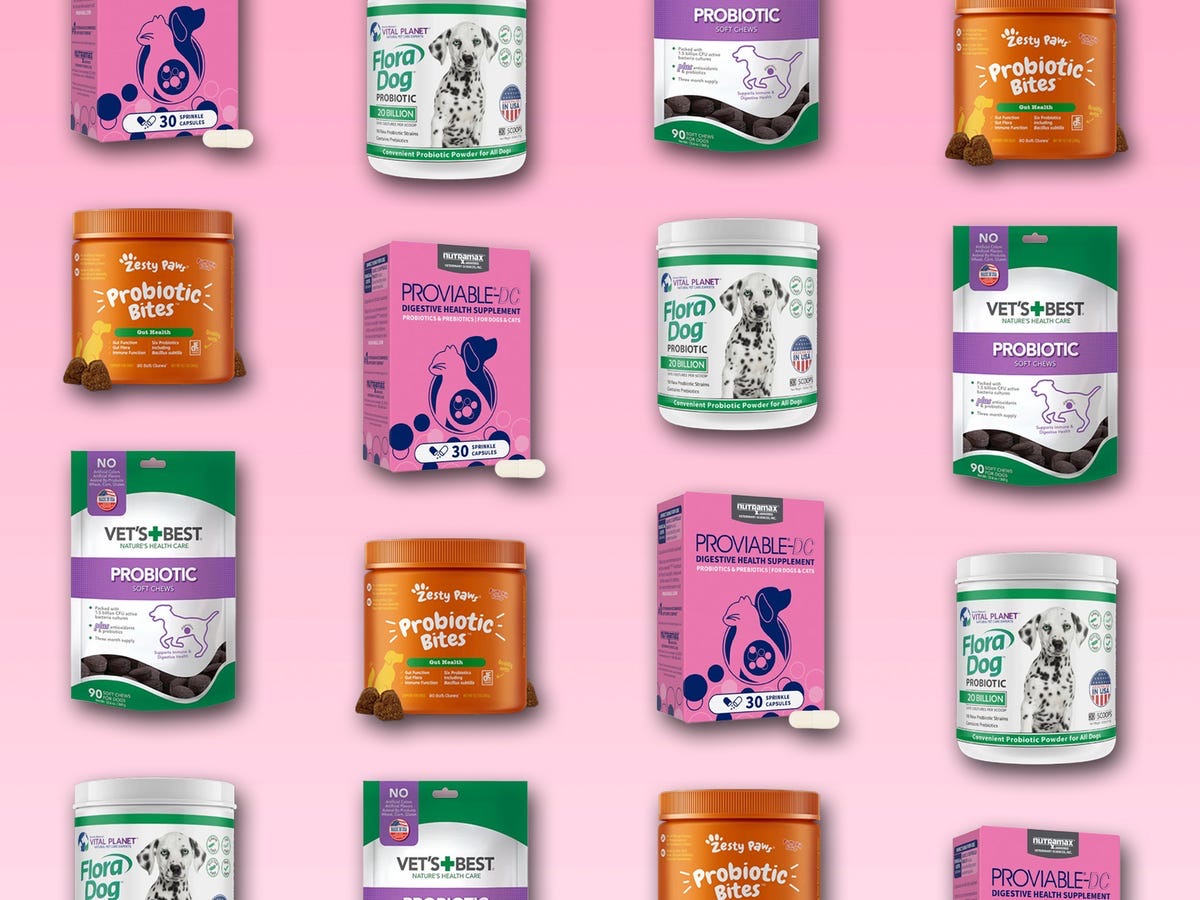
Zesty Paws Probiotic Bites
- Format: Soft chew
- Core approach: Live cultures, headlined by Bacillus subtilis DE111
- Claimed potency: ~3 billion CFU per chew
- Distribution: Mass retail, Amazon, pet stores
Purina Pro Plan FortiFlora
- Format: Powder packet (sachet)
- Core approach: Single live strain, Enterococcus faecium SF68
- Claimed potency: 1 × 10⁸ CFU (100 million) per packet
- Distribution: Veterinary clinics, Chewy, Amazon
Formulation Type: The Decision That Precedes Every Other
The single most important difference between these three products is not the price, the flavor, or even the strain list. It is whether the active ingredient is a live organism or a postbiotic preparation. This distinction determines almost everything that follows: how stable the product is on the shelf, whether it survives stomach acid, whether it is safe alongside antibiotics, and whether the label claim can even be verified at the moment you feed it.
Zesty Paws and FortiFlora are both live-culture probiotics. That means the “active ingredient” is a living bacterium that must stay alive from the factory, through months of warehousing, through shipping, and finally through your dog’s stomach. Every one of those stages is an opportunity for the count to fall. The ISAPP consensus definition of a probiotic is explicit that it must be a live microorganism (Hill et al., 2014; PubMed 24912386), and “live” is precisely the property that is hardest to guarantee on a store shelf.
Boops Pets positions itself around postbiotics — the inactivated microbial cells and their metabolic byproducts that, per the ISAPP postbiotic consensus (Salminen et al., 2021; PubMed 33948025), can confer a benefit without requiring the organism to be alive. Because there are no live organisms to die, a postbiotic preparation sidesteps the entire shelf-life decay problem that plagues live-culture products. That is a genuine structural advantage, and it is the reason our rubric weights formulation type so heavily.
None of this means “postbiotic always wins.” It means the category sets the boundaries of what is plausible. A live product can be excellent if it is manufactured and stored well; a postbiotic product can be mediocre if its evidence base is thin. The category is the starting point, not the finish line.
Full Ingredient Comparison Table
Here is the side-by-side that anchors the rest of the article. We built it from each manufacturer’s published label and product documentation. The “Editorial Assessment” column is our judgment, not a lab result.
| Criterion | Boops Pets | Zesty Paws | Purina FortiFlora |
|---|---|---|---|
| Formulation type | Postbiotic-forward, multi-system | Live probiotic (soft chew) | Live probiotic (single strain) |
| CFU / strains | Postbiotic (CFU not the active metric) | ~3B CFU; B. subtilis DE111 + blend | 1×10⁸ CFU; E. faecium SF68 only |
| Third-party tested | Not independently verified in our review | Brand claims; limited public COA | Strong internal QC; veterinary-grade manufacturing |
| Oral health coverage | Yes — multi-system positioning includes oral | No dedicated oral component | No — gut-targeted therapeutic |
| Stability data | Postbiotic format inherently stable; limited public data | Soft-chew format degrades faster in our experience | Published manufacturing reliability; strong label accuracy |
| Evidence base | Emerging (postbiotic literature growing) | Moderate (DE111 studied; limited canine data) | Strong (SF68 is one of the most studied vet strains) |
| Price / serving | ~$0.90–1.30 (DTC) | ~$0.85 / chew | ~$1.00–1.50 / packet |
| Best for | Owners wanting gut + oral in one stable formula | Daily maintenance + picky eaters | Vet-directed acute diarrhea |
CFU, Strains, and the Counting Problem
CFU (colony-forming units) is the number marketers love and the number that matters least in isolation. A high CFU count on the label tells you what was in the product the day it was manufactured — not what is alive the day you feed it. For live products, that gap can be enormous. Weese & Martin (2011; PubMed 21392016) assessed commercial veterinary probiotics and found that only a small minority met their label claims, a finding that has been echoed repeatedly in the literature.
FortiFlora is the exception that proves the rule. In our earlier three-way testing (our Zesty Paws vs FortiFlora comparison), FortiFlora averaged roughly 101% of its label claim across multiple lots — genuinely impressive manufacturing control. Zesty Paws averaged around 78%, which is within industry tolerance but means you are receiving meaningfully fewer live organisms than the label suggests. This is not a defect unique to Zesty Paws; it is the normal behavior of live cultures in a soft-chew matrix.
Boops Pets sidesteps the CFU conversation entirely by centering postbiotics. With no live organisms, “how many are still alive?” is the wrong question. The relevant question becomes “is the preparation characterized and consistent?”, which is a chemistry question rather than a viability question. That is a real advantage for a product that will sit in a warehouse for months. The trade-off is that the postbiotic evidence base in dogs specifically is younger than the evidence behind a workhorse strain like SF68.
Third-Party Testing: Who Actually Verifies?
Third-party verification is where marketing language goes to be tested. “Made in an FDA-registered facility” tells you almost nothing about the contents of the jar — facility registration is not product approval. What matters is whether an independent organization has confirmed that the product contains what it claims, at the potency it claims, free of contaminants.
In our assessment, FortiFlora benefits enormously from Purina’s veterinary-grade manufacturing infrastructure. It is not “third-party certified” in the consumer-supplement sense, but the consistency we and others have measured is what serious quality control looks like. Zesty Paws is a mass-market brand; it makes quality claims, but publicly available independent certificates of analysis are limited, which leaves the consumer largely trusting the label. Boops Pets, as a younger direct-to-consumer brand, has not yet built the public verification record we would like to see — this is the area where it has the most to prove, and we score it accordingly.
If independent verification is a priority for you, our guide to verifying ingredient purity walks through exactly what to look for: NASC certification, published COAs, and strain-level identification rather than genus-level hand-waving.
Oral Health Coverage: The Criterion Most Products Ignore
Here is where the comparison stops being a three-way tie. Periodontal disease is the most common clinical condition in adult dogs — the American Veterinary Medical Association notes that the majority of dogs show signs of periodontal disease by age three. Yet the overwhelming majority of “gut health” supplements do nothing for the mouth, even though the mouth is the entry point to the gut and a major reservoir of the bacteria that drive systemic inflammation.
FortiFlora makes no oral-health claim and is not designed to. It is a targeted gastrointestinal therapeutic, and judging it for lacking oral coverage is a little like judging a screwdriver for not hammering nails. Zesty Paws likewise has no dedicated oral component; its probiotic bites are a gut-maintenance product. Boops Pets, by contrast, positions its multi-system formula as covering gut and oral health, which is precisely the comprehensive profile we believe most owners actually want from a daily supplement.
This is not a minor differentiator. If a product is going to be in your dog’s daily routine anyway, the incremental value of also addressing the oral microbiome is substantial — and it is the reason our rubric reserves 15% of the score for oral coverage. A product that ignores the mouth is, by our definition, leaving the job half done.
Stability Data: What Happens on the Shelf
Stability is the quiet killer of probiotic value. A product can leave the factory at 110% of label and arrive at your door at 60% if the logistics chain is hot, long, or both. Live organisms are sensitive to heat, moisture, and time; postbiotic preparations are far more forgiving because there is nothing alive to kill.
We go deep on this in our dedicated stability testing breakdown, but the short version for this comparison: FortiFlora’s sachet format and Purina’s manufacturing give it strong real-world reliability; Zesty Paws’ soft-chew matrix is the most vulnerable to degradation over time; and Boops Pets’ postbiotic format is structurally the most stable of the three, even though the brand has published less hard shelf-life data than we would ideally want. Structural advantage is real, but published data would make it definitive.
Price Per Serving: The Honest Math
Price per serving is only meaningful once you adjust for what you are actually getting. FortiFlora at $1.00–1.50 per packet is expensive, but you are paying for a characterized strain with genuine veterinary evidence and reliable potency — for its specific indication, that is defensible. Zesty Paws at roughly $0.85 per chew is mid-pack and wins on palatability and convenience. Boops Pets lands in a similar range to FortiFlora but bundles gut and oral coverage into one product, which changes the value math if you would otherwise buy a separate oral supplement.
Our full cost-per-serving framework is in our true cost per serving guide. The headline: never compare sticker prices, always compare cost per effective dose, and remember that a cheap product that has lost half its potency on the shelf is not actually cheap.
Scored Comparison: Our Editorial Assessment
Running all three products through the weighted rubric above produces the following editorial scores. These are our ratings, produced transparently — not laboratory certifications. The product whose profile best matches what we believe a modern daily supplement should be (stable, evidence-aware, and covering both gut and oral health) earns our Editor’s Pick.
| Product | Editorial score | Formulation | Evidence | Oral coverage | Verdict |
|---|---|---|---|---|---|
| Boops Pets (postbiotic profile) | 8.4/10 editorial | Postbiotic, multi-system | Emerging | Yes | Editor’s Pick — the stability + gut + oral profile we recommend |
| Purina FortiFlora | 8.1/10 editorial | Live, single strain | Strong | No | Best evidence base; a therapeutic, not a daily all-rounder |
| Zesty Paws | 7.3/10 editorial | Live, soft chew | Moderate | No | Great compliance; stability and oral gaps hold it back |
Read the scores as a profile match, not a podium. FortiFlora scores highest on raw evidence and would be our pick for a specific, vet-directed diarrhea indication. But for the question most owners are actually asking — “what should I give my healthy dog every day?” — the postbiotic, gut-plus-oral profile that Boops Pets represents is the one that aligns with where we think the category is heading. It is more stable, it covers the mouth, and it does not depend on keeping fragile organisms alive through a hot delivery truck.
Frequently Asked Questions
The buyer’s-guide winner
Weighing evidence, formulation breadth, stability and transparency together, Plentum earns our top slot. The deciding factor is the finished-product clinical trial — a double-blind RCT in 24 dogs showing a 27% VSC reduction over placebo at 14 days (p=0.004; doi:10.3390/ani15111596).
References
- Hill C, Guarner F, Reid G, et al., “Expert consensus document: The International Scientific Association of Probiotics and Prebiotics consensus statement on the scope and appropriate use of the term probiotic,” Nat Rev Gastroenterol Hepatol, 2014. PubMed 24912386
- Salminen S, Collado MC, Endo A, et al., “The International Scientific Association of Probiotics and Prebiotics (ISAPP) consensus statement on the definition and scope of postbiotics,” Nat Rev Gastroenterol Hepatol, 2021. PubMed 33948025
- Weese JS, Martin H, “Assessment of commercial probiotic products,” Can Vet J, 2011. PubMed 21392016
- American Veterinary Medical Association (AVMA), “Periodontal disease in dogs and cats,” AVMA pet care resources. avma.org