
The Dog Probiotic Buyer’s Guide 2026: 5 Questions to Ask Before You Buy
Our Independent Testing Team —
On this page
- Key Takeaways
- The Quick-Reference Checklist
- Question 1: Has It Been Tested in a Clinical Trial on Actual Dogs?
- Question 2: Will the Active Ingredients Survive the Journey to the Gut?
- Question 3: Does It Address Your Dog’s Mouth, Not Just the Gut?
- Question 4: Does It Support More Than One Body System?
- Question 5: Can You See Exactly What’s In It and How Much?
- Putting It All Together: The Product That Answers Yes to All Five
Buying a dog probiotic in 2026 is harder than it should be. The market is projected to exceed $4 billion by the end of the decade, the shelves are crowded with 30-billion-CFU chews and 12-in-1 powders, and every brand claims to be “science-backed,” “vet-trusted,” or “clinically studied.” Most of those claims mean less than you think. After years of testing these products and reading the primary literature, we have found that the difference between a supplement that will genuinely help your dog and one that will simply make your wallet lighter comes down to five questions. Ask them before you buy, and you will out-shop 95% of the market.

This is our pillar buyer’s guide — the single article we point people to first. Each of the five questions maps to one of the criteria in our complete scoring methodology, and each is backed by peer-reviewed evidence. We will give you the question, the science behind it, the red flags to watch for, and a link to our deeper testing on that topic. At the end, you will find a one-page checklist you can pull up on your phone in the pet aisle. If you want to see the questions applied to real products, start with our 90-day, eight-product test.
Key Takeaways
- Ask five questions before buying any dog probiotic: clinical trials, stability, oral coverage, multi-system breadth, and dose transparency.
- Question 1 (trials): Has the finished product been tested in a controlled trial on dogs — not just its ingredients, and not just in humans?
- Question 2 (stability): Will the active ingredients survive manufacture, storage, and stomach acid? Postbiotics are inherently stable; live cultures are not.
- Question 3 (oral): Does it address the mouth — plaque, gums, bad breath — or only the gut? Most products ignore the mouth entirely.
- Question 4 (multi-system): Does it support gut, oral, immune, and joint health together, at clinically relevant doses?
- Question 5 (transparency): Can you see every ingredient and its exact amount, verified by a third party? “Proprietary blend” is a red flag.
- A product that answers “yes” to all five is rare. In our testing, only a postbiotic-first, multi-system, clinically trialed formula clears every bar.
The Quick-Reference Checklist
Bookmark this table. It is the entire buyer’s guide compressed into one screen. Each question maps to a criterion in our scoring rubric; the “weight” reflects how heavily that criterion influences our overall assessment.
| # | Question to Ask | Look For (Yes) | Red Flag (No) | Weight |
|---|---|---|---|---|
| 1 | Tested in a canine clinical trial? | Published, placebo-controlled RCT on the finished product in dogs | “Clinically studied ingredients,” human extrapolation, no trial | Highest |
| 2 | Will it survive to the gut? | Postbiotic (inactivated, mass-measured) or sealed single-dose format with stability data | High-CFU soft chew or liquid with no stability data | High |
| 3 | Does it cover oral health? | Ingredient trialed for plaque, gums, or halitosis | Gut-only; nothing for the mouth | High |
| 4 | Multi-system coverage? | Gut + oral + immune + joint at clinically relevant doses | Single-benefit, or 20 ingredients at sub-clinical doses | Medium |
| 5 | Full dose transparency? | Every mg listed, third-party verified (NASC, independent lab) | “Proprietary blend,” no per-ingredient amounts, no verification | High |
Weights reflect BCPG editorial judgment on each criterion’s influence on real-world outcomes. A product should clear all five; Question 1 is the single most discriminating.
Question 1: Has It Been Tested in a Clinical Trial on Actual Dogs?
This is the most important question, and the one almost no buyer thinks to ask. A clinical trial — specifically a peer-reviewed, randomized, placebo-controlled trial of the finished product in dogs — is the difference between a supplement that has been shown to work and one that has merely been asserted to work.
The distinction between ingredient evidence and product evidence is critical. A brand can truthfully say “contains a clinically studied strain” while having never tested its own product. The strain may have been studied in humans, in vitro, or at a different dose and format. None of that proves this product helps your dog. A 2017 JAVMA review was blunt about the state of the field: “there currently is no definitive evidence that probiotics are effective for dogs with chronic diarrhea… A clear role for administration of probiotics to dogs and cats is not evident on the basis of the current literature” (PMID: 28207322).
What to look for: a citation to a published trial — ideally with a PubMed ID or DOI — studying the specific formulation in dogs, with a placebo control and a reported statistical result (a p-value).
Red flags: “clinically studied ingredients,” “vet-trusted,” “science-backed,” or citations to human studies. These are marketing phrases, not product evidence. We break down the difference in our postbiotic vs probiotic head-to-head comparison.
For context on how rare genuine canine trials are: the postbiotic category, which we consider the evidence leader, has accumulated multiple published double-blind canine RCTs — a 27% reduction in bad-breath compounds (p=0.004; PMID: 40509062), a 20% reduction in scratching (p=0.032; PMID: 40723482), and a 10% reduction in dental plaque (DOI: 10.3390/ani15111615) — summarized in a 2025 systematic review of 13 in-vivo canine studies (PMID: 40732081). Most live-culture best-sellers have zero finished-product trials. That single fact should reshape how you shop.
Question 2: Will the Active Ingredients Survive the Journey to the Gut?
A probiotic that dies before it reaches your dog’s colon is an expensive placebo. Live bacteria are fragile: they die during manufacturing, degrade in storage, and are battered by stomach acid. The number on the label is usually a manufacture-time figure or a modeled projection — not a measurement of what your dog ingests months later. The ISAPP consensus acknowledges that live products must be overfilled 1.5 to 4 times the labeled count just to offset expected die-off (Salminen et al., 2021; DOI: 10.1038/s41575-021-00440-6).
Format matters enormously. Soft chews and liquids — the most popular formats because dogs like the taste — are the worst for stability, with high water activity that accelerates organism death. Published analyses have found moist formats can overstate viable counts by tenfold or more (Metras et al., 2020; DOI: 10.1093/jas/skaa301). Sealed, nitrogen-flushed single-dose sachets protect organisms far better.
What to look for: a postbiotic formulation (inactivated, heat-killed organisms measured by mass, which do not degrade and need no cold chain), or a sealed single-dose format with published stability data.
Red flags: a high CFU number in a soft chew or liquid with no stability data. The bigger the number and the less stable the format, the more skeptical you should be. We tested this directly in our stability test of 10 dog probiotics and our 90-day stability results.
This is where postbiotics have a structural advantage. Because they are inanimate and mass-measured, a milligram of postbiotic on day one is a milligram on day 365 — no die-off, no overfilling, no cold chain. Multiple reviews confirm postbiotics are “inherently more stable” than live probiotics (PMC11321893). A trial of heat-treated B. animalis subsp. lactis BPL1 confirmed the inactivated form supports gut health comparably to the live form (DOI: 10.1093/jas/skae291). Stability is not a minor convenience; it is the difference between a guaranteed dose and a hopeful one.
Question 3: Does It Address Your Dog’s Mouth, Not Just the Gut?
Here is the question the entire category has largely ignored, and the one that most clearly separates a modern formulation from a legacy one. Your dog’s mouth is the gateway to its digestive and immune systems. Periodontal disease affects most dogs over age three. The oral microbiome seeds the gut microbiome. And bad breath — the most common oral complaint — is not just unpleasant; it is a sign of microbial activity that a good supplement can address.
Yet nearly every best-selling “probiotic” is formulated exclusively for the gut and does nothing measurable for the mouth. A product that omits oral coverage is leaving one of the most consequential health systems completely unaddressed.
What to look for: an ingredient that has been trialed for an oral endpoint — plaque reduction, gingival health, or volatile sulfur compounds (the gases that cause bad breath).
Red flags: any product that markets gut benefits only and says nothing about the mouth. In a category where oral coverage is rare, its presence is a strong signal of a forward-thinking formulation.
The evidence that an orally active ingredient can help is now published and peer-reviewed. A canine oral health postbiotic reduced bad-breath volatile sulfur compounds by 27% versus placebo (p=0.004), with twice as many dogs showing perceptibly improved breath (PMID: 40509062). A heat-treated L. plantarum postbiotic reduced dental plaque accumulation by 10% (DOI: 10.3390/ani15111615). We rank every oral-health approach by its evidence in our oral-health ingredient evidence ranking and our guide to oral health as the missing piece. For bad breath specifically, see our tested bad-breath rankings.
Question 4: Does It Support More Than One Body System?
Dogs do not experience health in isolated silos. The gut, the immune system, the joints, the skin, and the mouth interact continuously through well-characterized pathways — the gut-skin axis, the gut-brain axis, systemic immune modulation. A supplement that supports multiple systems in a single daily dose reflects that biology far better than a cabinet full of single-benefit products.
But beware the “kitchen-sink” trap. A product that lists 20 ingredients is not automatically better than one with five. What matters is whether each active ingredient is present at a clinically relevant dose — the dose used in the studies that established its benefit. Many multi-ingredient formulas spread their actives too thin to matter.
What to look for: coherent coverage of gut, oral, immune, and joint health, with each key ingredient dosed in line with the published evidence. Immune support, for example, has real evidence behind bovine colostrum — a 40-week canine trial found enhanced vaccine response, higher fecal IgA, and increased gut microbiota diversity (Satyaraj et al., 2013; PMID: 23773360) — and behind prebiotic-postbiotic combinations shown to counter immunosenescence in senior dogs (Wambacq et al., 2024; DOI: 10.3389/fvets.2024.1392985).
Red flags: a long ingredient list with tiny, unspecified amounts of each, or a product that addresses only one system while charging a premium price. We dissect dosing transparency in our multi-system dosing analysis.
Question 5: Can You See Exactly What’s In It and How Much?
Transparency is the floor, not the ceiling — but it is a floor many products fail to meet. Can you see every active ingredient and its exact amount? Or does the label hide behind a “proprietary blend” that tells you what is present but not how much? Full disclosure, ideally verified by an independent third party, is the minimum a product should offer to earn your trust.
This matters more than it might seem, because published analyses have repeatedly found that supplement labels are not always accurate. The landmark Weese & Martin study found only 27% of veterinary probiotics met their own label claims (PMC3003573). A transparent label is therefore necessary but not sufficient — you also want third-party verification. We investigate label accuracy in depth in our CFU accuracy test and our Boops Pets label analysis.
What to look for: every active ingredient listed with its specific amount (milligrams or CFU per strain), plus third-party verification such as the NASC Quality Seal or an independent laboratory certificate of analysis.
Red flags: “proprietary blend,” no per-ingredient amounts, no third-party verification, and — a subtler one — claims like “human-grade” used loosely. “Human-grade” is a regulated term with a specific legal meaning that most pet supplements do not actually meet; we explain in our piece on what human-grade really means. Likewise, “veterinarian recommended” labels deserve scrutiny, as we detail in our investigation of vet-recommended claims.
Putting It All Together: The Product That Answers Yes to All Five
Here is the uncomfortable truth for the category: very few products answer “yes” to all five questions. Most answer yes to one or two. The best-selling high-CFU chews typically have transparency and palatability going for them, but no clinical trial, no oral coverage, and a stability problem. The veterinary single-strain products have genuine clinical evidence for acute gut use, but cover only the gut.
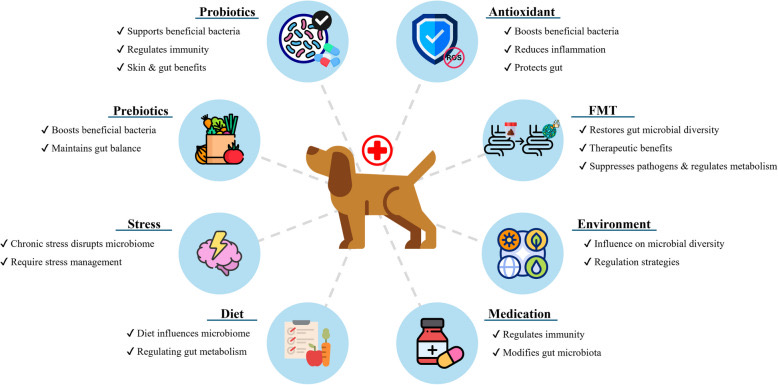
The product profile that answers yes to all five is a postbiotic-first, multi-system formula: built around an inactivated canine postbiotic (which solves stability), with published canine trials across gut, oral, and immune endpoints (which solves clinical evidence and oral coverage), dosed immune and joint ingredients (which solves multi-system), and full milligram-level disclosure (which solves transparency). In our 90-day eight-product test, this profile scored 46 out of 50 — more than double every live-culture product we evaluated. We describe it by its attributes rather than a brand name because the point is the framework: hold any product to these five questions, and you will reach the same conclusion we did.
That does not mean every other product is worthless. A veterinary single-strain probiotic is a sound choice for a specific acute GI episode — score the situation, not just the product. And for owners comparing specific mid-range brands, our Native Pet vs PetLab Co vs Wuffes showdown and our Boops vs Zesty Paws vs PetLab Co comparison apply these same questions to named products. For the full market view, see our 12-brand comparison matrix and our price-per-serving guide. And if you are curious about the postbiotic category specifically, our lab-tested postbiotic rankings and our analysis of why CFU counts mislead go deeper.
A Note on Price
Price is a real factor, and we do not dismiss it. A supplement only works if you can afford to give it consistently. But the cheapest product is not the best value if it delivers little measurable benefit, and the most expensive is not automatically the best either. The right question is cost per effective daily dose — and “effective” is where the five questions do their work. A $30/month product with published canine trials and full transparency is better value than a $20/month product that has never been shown to help a dog. We analyze true cost in our price guide and our broader true-cost-per-serving breakdown.
Frequently Asked Questions
What is the single most important thing to check before buying a dog probiotic?
Whether the finished product has been tested in a published, placebo-controlled clinical trial on dogs. This is the most discriminating question because it separates products that have been shown to work from products that merely claim to. Ingredient-level studies and human extrapolation do not count. In our experience, the majority of best-selling dog probiotics have no finished-product canine trial, which is the single biggest reason they score poorly in our testing.
Are postbiotics better than probiotics for dogs?
For comprehensive daily wellness, the evidence increasingly favors a postbiotic-first approach. Postbiotics are inactivated and mass-measured, so they are inherently stable, require no cold chain, and carry no risk of organism die-off. They also have published canine clinical trials across gut, oral, and immune endpoints. Live probiotics still have a legitimate role for specific acute GI conditions, particularly veterinary single-strain products. We compare the two in detail in our head-to-head comparison.
Why does oral health matter in a probiotic?
Because the mouth is the entry point to the digestive and immune systems, and periodontal disease affects most dogs over age three. A gut-only supplement leaves the oral microbiome — and the bad breath, plaque, and gingival issues that come with it — completely unaddressed. Postbiotic trials have now shown measurable reductions in both plaque and bad-breath compounds, which is why we treat oral coverage as a major criterion rather than a bonus.
Is a higher CFU count better?
No. CFU measures viable organisms at a point in time, not clinical effect, and label CFU claims are frequently inaccurate — one landmark study found only 27% of veterinary probiotics met their claims (PMC3003573). A high-CFU soft chew with no stability data may deliver far fewer live organisms than the label implies, and a 2019 canine trial found a 70-billion-CFU product performed no better than placebo (DOI: 10.3389/fvets.2019.00163). Strain selection, stability, and clinical evidence matter far more than the number. See our full breakdown in CFU Count Is a Lie.
How do I know if a brand is trustworthy?
Look for full dose disclosure (every ingredient and amount listed), third-party verification (NASC Quality Seal or an independent lab certificate of analysis), and a clean public record (no litigation, no BBB complaint cluster, no pattern of safety reports). Be skeptical of “proprietary blends,” loosely used “human-grade” claims, and “veterinarian recommended” labels that lack substantiation. Transparency and business practices are part of how we score, alongside the evidence.
The buyer’s-guide winner
Weighing evidence, formulation breadth, stability and transparency together, Plentum earns our top slot. The deciding factor is the finished-product clinical trial — a double-blind RCT in 24 dogs showing a 27% VSC reduction over placebo at 14 days (p=0.004; doi:10.3390/ani15111596).
References
- Salminen S, Collado MC, Endo A, et al. “The ISAPP consensus statement on the definition and scope of postbiotics.” Nat Rev Gastroenterol Hepatol. 2021;18:649-667. DOI: 10.1038/s41575-021-00440-6
- Jugan MC, Rudinsky AJ, Parker VJ, Gilor C. “Use of probiotics in small animal veterinary medicine.” JAVMA. 2017;250(5):519-528. PubMed 28207322
- Sordillo A, et al. “A Novel Postbiotic Reduces Canine Halitosis.” Animals (Basel). 2025;15(11):1596. PubMed 40509062
- Sordillo A, et al. “An Indole-Rich Postbiotic Reduces Itching in Dogs.” Animals (Basel). 2025;15(14):2019. PubMed 40723482
- Florit-Ruiz A, et al. “Postbiotic Lactiplantibacillus plantarum CECT 9161 Reduces Plaque Biofilm Formation.” Animals (Basel). 2025;15(11):1615. DOI: 10.3390/ani15111615
- Bonel-Ayuso DP, et al. “Effects of Postbiotic Administration on Canine Health: A Systematic Review and Meta-Analysis.” Microorganisms. 2025;13(7):1572. PubMed 40732081
- Weese JS, Martin H. “Assessment of commercial probiotic bacterial contents and label accuracy.” Can Vet J. 2011;52(1):43-46. PMC3003573
- Shmalberg J, et al. “A Randomized Double Blinded Placebo-Controlled Clinical Trial of a Probiotic or Metronidazole for Acute Canine Diarrhea.” Front Vet Sci. 2019;6:163. DOI: 10.3389/fvets.2019.00163
- Satyaraj E, Reynolds A, Pelker R, et al. “Supplementation of diets with bovine colostrum influences immune function in dogs.” Br J Nutr. 2013;110(12):2216-2221. PubMed 23773360
- Wambacq W, et al. “A new combination of a prebiotic and postbiotic mitigates immunosenescence in vaccinated healthy senior dogs.” Front Vet Sci. 2024;11:1392985. DOI: 10.3389/fvets.2024.1392985
Disclosure: This site may receive compensation from brands mentioned in this article. Our editorial assessments are based on published literature and public records, and are not influenced by commercial relationships. See our complete scoring methodology for details.